- Home
- |
- News - Event
- |
- Others
MANY LIMITATIONS, OBSTACLES IN THE PROCESS OF IMPLEMENTING BINH DUONG'S WATER SUPPLY AND SEWERAGE POLICIES
The survey delegation from the National Assembly's Committee on Science, Technology, and Environment has pointed out numerous limitations and obstacles in the process of implementing Binh Duong's water supply and sewerage policies.
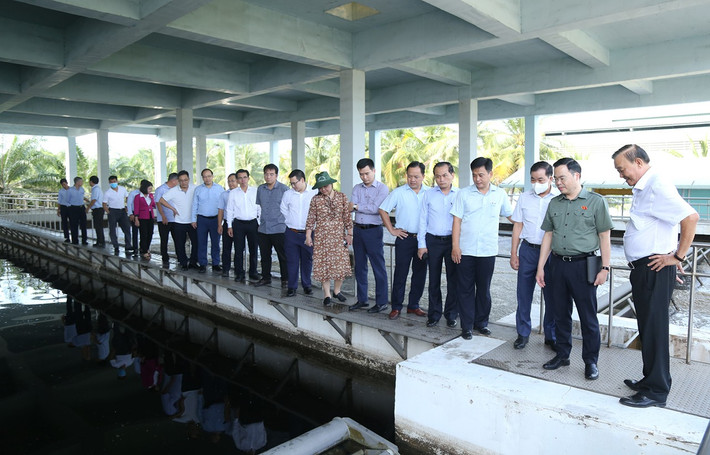
The survey delegation at Biwase's wastewater treatment plant in Phu Tan Ward, Thu Dau Mot City. Photo: Văn Dung
On February 26, a survey delegation from the National Assembly's Committee on Science, Technology, and Environment, led by Deputy Chairman Ta Dinh Thi, conducted an assessment of the implementation of legal policies on water supply and sewerage in Binh Duong Province.
According to the report from the Binh Duong Provincial People's Committee, the proportion of households provided with clean and hygienic water is estimated at 99.65%; the rate of urban wastewater collection and treatment in the province reaches approximately 38%.
For industrial zones (IZs) operating in the province, 100% of the IZs have invested in centralized wastewater treatment systems and are equipped with automatic wastewater monitoring systems, with data connected to the Department of Natural Resources and Environment. Enterprises within the industrial zones have relatively well-implemented connections of wastewater to the centralized treatment systems, basically achieving a 100% rate; the treated wastewater regularly meets environmental standards.
Regarding the current state of urban water supply, the urban areas of Binh Duong have eight water plants with a total capacity of 690,000 m³/day, reaching 78% of the designed capacity. The total land area of the current water plants is about 50 hectares, divided into four water supply zones in the urban areas
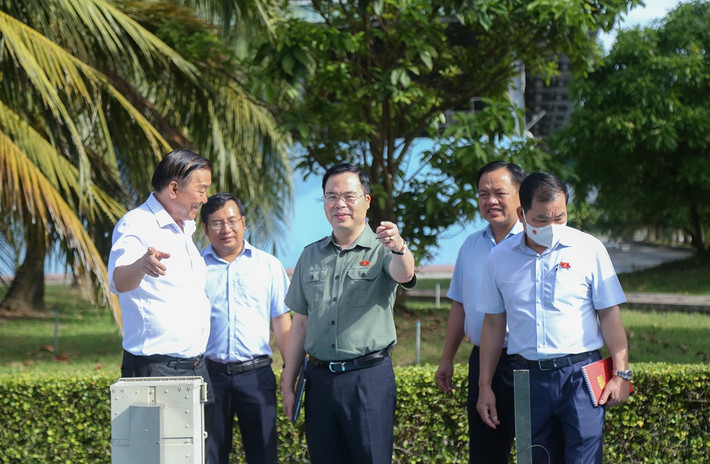
In addition to the achievements, the delegation pointed out numerous limitations and obstacles in the process of implementing Binh Duong's water supply and sewerage policies. Photo: Van Dung
Regarding the current state of rural water supply, there are currently 31 centralized rural water supply projects providing water to 31 communes, managed and operated by the Center for Investment, Exploitation of Irrigation, and Rural Clean Water (under the Irrigation Department). Additionally, Biwase manages four centralized rural water supply projects, supplying water to one commune and three wards (Dat Cuoc commune, Tan Phuoc Khanh ward, Hoi Nghia Ward, and Tan Thanh township).
In terms of rural water usage and supply capacity, all communes in rural areas have been provided with water from either urban water supply systems or rural water supply stations. The proportion of rural areas supplied by centralized water systems is 53%.
Regarding the management and treatment of urban wastewater, there are currently four localities in the province with wastewater treatment plants and wastewater collection networks. These include Thu Dau Mot City, with a wastewater treatment plant designed for a capacity of 17,560 m³/day; Thuan An City, with a plant designed for 17,000 m³/day; Di An City, with a plant designed for 20,000 m³/day; and Tan Uyen City, with a plant designed for 15,000 m³/day
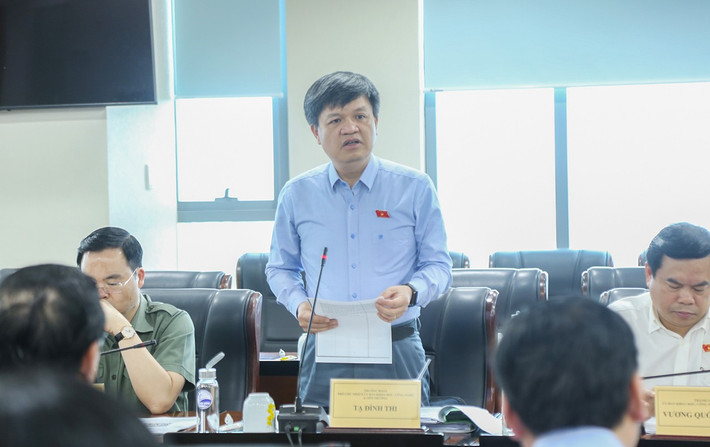
Vice Chairman of the Committee of Science, Technology and Environment Ta Dinh Thi at the working session with the People's Committee of Binh Duong Province.
Photo: Van Dung
Dr. Tran Van Khai, full-time National Assembly Deputy working at the National Assembly’s Committee on Science, Technology and Environment, assessed that Binh Duong has achieved many positive results in the implementation of policies and laws on water supply and sewerage.
Despite these achievements, Binh Duong still faces many limitations and obstacles in the implementation of water supply and sewerage policies. Specifically, many urban areas in the province (especially in newly developing districts such as Bau Bang, Phu Giao, and Dau Tieng) do not yet have fully developed centralized wastewater treatment systems. Even in areas where treatment plants exist, the household connection rate remains low and uneven, mostly concentrated in central areas. As a result, only about 38% of urban wastewater is treated, while the rest is still discharged into the environment, posing a potential risk of water pollution.
The development of sewerage infrastructure has not kept pace with the rapid industrialization and urbanization of Binh Duong. Many wastewater collection and treatment projects are progressing slowly due to funding shortages. The collection systems are not uniformly developed, preventing some businesses and residential areas from connecting to existing treatment plants.
Budgetary resources allocated to this sector remain limited, while mechanisms to attract private investment have not been effective, resulting in infrastructure gaps in newly developed urban areas
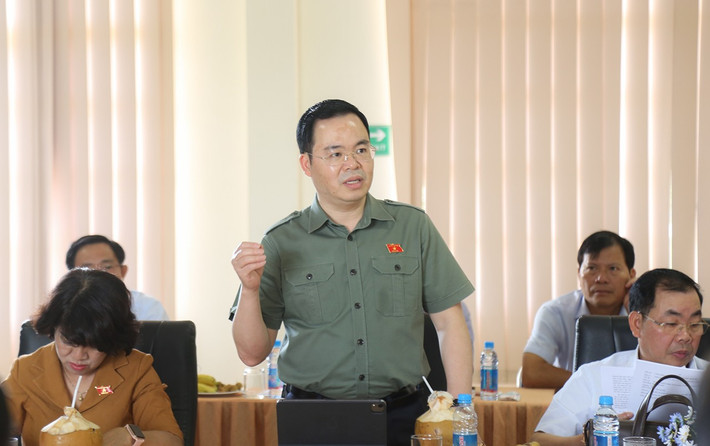
Dr. Tran Van Khai, a full-time National Assembly Deputy working at the National Assembly's Committee of Science, Technology, and Environment, provided assessments and observations during the implementation of water supply and sewerage policies in Binh Duong.
Photo: Van Dung
In addition, Binh Duong faces difficulties in managing water prices and sewerage services; the process of developing and approving clean water prices and sewerage service fees encounters regulatory obstacles.
Another challenge is the requirement that water supply companies must bear the costs of relocating or reinforcing pipelines located within road corridors when roads are expanded. This regulation (under traffic law) imposes a significant financial burden on water supply companies, reducing their incentive to expand the network.
Similarly, a provision in the draft Law requiring households to self-fund the installation of pipelines from their homes to public connection points also faces practical difficulties: many townhouses lack rear access for sewerage, necessitating the excavation of house foundations for connection, which incurs very high costs
Some production facilities in the area have not strictly complied with environmental protection laws, with instances of secretly discharging untreated wastewater into receiving water bodies still occurring. The indiscriminate dumping of garbage and solid waste into drains, canals, and streams also contributes to flow blockages and localized flooding.
These behaviors indicate that environmental inspection and monitoring efforts in some areas lack decisiveness, and the compliance awareness of certain businesses and residents remains low.
Notably, current laws do not yet provide regulations on supporting connection costs for residents when implementing new sewerage systems. This poses challenges for local authorities if they wish to subsidize costs or introduce policies to encourage households to connect to the sewerage network.
Additionally, incentive mechanisms for private investors participating in the water supply and sewerage sector are not yet clear, resulting in the mobilization of social resources falling short of expectations
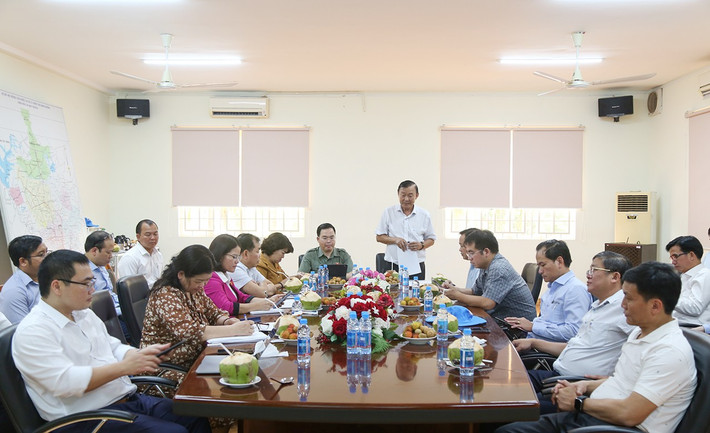
The delegation worked with Biwase after a survey of three plants
Photo: Van Dung
Deputy Tran Van Khai stated that Binh Duong is currently facing the need to upgrade its water supply and sewerage management to keep pace with urban and industrial development. The lessons learned and challenges faced by Binh Duong serve as an important basis for refining the upcoming legal framework on water supply and sewerage.
Incorporating regulations on service pricing, connection support mechanisms, investment incentives, and water resource protection into the new Law will help address current bottlenecks, creating favorable conditions for localities like Binh Duong to more effectively implement water supply and sewerage tasks.
Concluding the survey and working session, Deputy Chairman of the Committee on Science, Technology, and Environment Ta Dinh Thi stated that the delegation had conducted surveys, listened to, recorded, and comprehensively compiled the opinions of deputies and representatives from departments and sectors in Binh Duong. At the same time, he requested the Binh Duong Provincial People's Committee to finalize their report in the spirit of incorporating the comments made by deputies, departments, agencies, and units of the province, particularly the opinions and recommendations of the Binh Duong Water – Environement Corporation JSC (Biwase).
He also urged the Ministry of Construction to take into account the deputies' opinions to refine the draft Law and report to the National Assembly Standing Committee and the Government
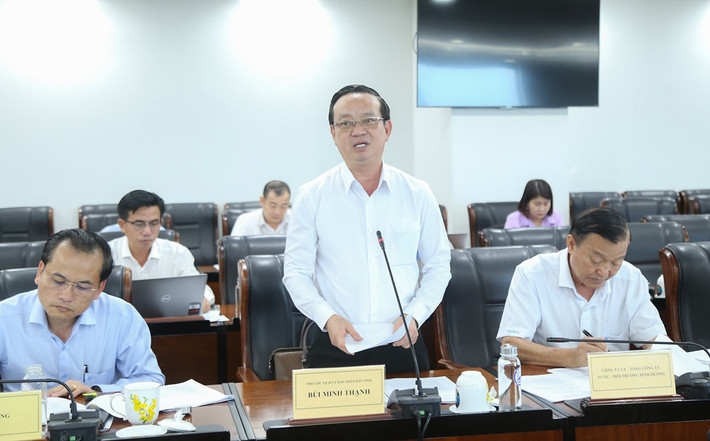
Vice Chairman of the Binh Duong Provincial People's Committee Bùi Minh Thạnh at the working session with the survey delegation.
Photo: Văn Dũng
Through the working session, the delegation identified several prominent issues, among which the issue of water pricing and sewerage services stands out, requiring a review of legal regulations as the top priority. Secondly, regarding investment in developing water supply and sewerage systems, adopting a science and technology-based approach will help improve the urban landscape.
Vice Chairman of the Binh Duong Provincial People's Committee Bui Minh Thanh expressed gratitude to the delegation for their practical contributions to Binh Duong and affirmed a serious and receptive attitude in addressing the shortcomings pointed out by the National Assembly's Committee on Science, Technology, and Environment
According to: Van Dung
Source:https://daibieunhandan.vn/nhieu-han-che-vuong-mac-trong-qua-trinh-thuc-hien-chinh-sach-cap-thoat-nuoc-cua-binh-duong-post405818.html
Others Other



.jpeg)
Date: 15-08-2024
Two Vietnamese Stocks Added to the MSCI Frontier Market Index

Date: 16-09-2023
VIETNAM WATER WEEK 2023 ORGANIZATION COMMITTEE'S CONTACT INFOR
Date: 21-06-2017
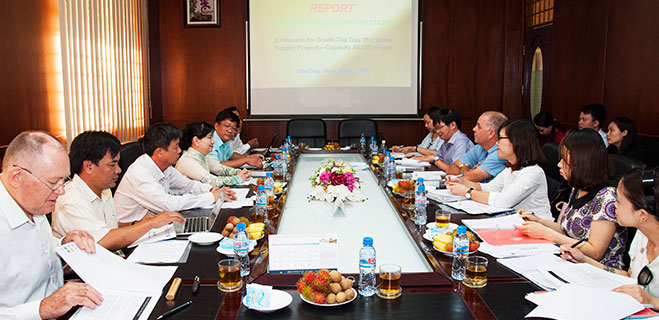
BIWASE hosted ABD mission
Date: 12-01-2017